

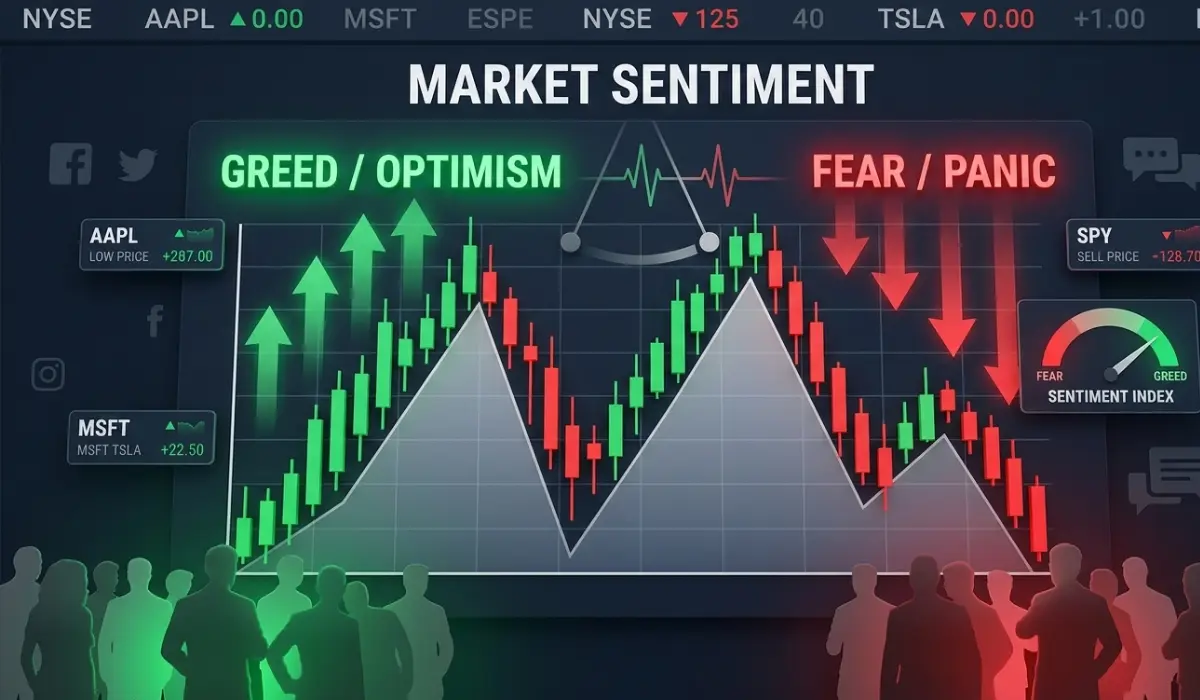
Over the past five years, Dow (DJIA), the index that shows the performance of 30 large firms in America, grew 63%, while a sentiment-fueled metal (Gold) with no earnings grew 177%. This underscores how sentiment trumps company fundamentals, rigorous research data, and even much-hyped tech prospects.
Even during this AI boom, safe havens are outperforming big tech leaders like Google and Nvidia. It’s interesting how gold’s soaring value is almost pure sentiment- fear and greed cycles without relatively smaller fundamentals.
An investor approaching the market with thorough fundamentals, but discounting the sentiment beyond the numbers, often makes disastrous moves. Market sentiment is an invisible force that biases the terrain where numerous other forces move and interact with each other.
This article attempts to approach market sentiment systematically to instrumentalise it in market decisions. The article is divided into three sections: Mechanisms, Indicators, and Impacts. The first section focuses on understanding what causes the sentiment, while the second discusses how to identify it, and the third discusses how it biases the outcome.
Mechanisms: The Psychological Engines Behind Sentiment Swings
Behavioural Finance, a sub-branch of psychology, studies cognitive biases that explain certain market patterns primarily caused by human behaviour and biases in thinking. Although the field extends beyond the market movements and into personal finance, let’s keep this article’s scope limited to the former axis. Here are some psychology-driven market patterns:
Herd Behaviour
This is where the investors mimic each other and follow the crowd blindly, even against stronger fundamentals. This often has a snowball effect in the market, where share prices are way undervalued or way overvalued due to the general sentiment on its prospects. Any market movement above a threshold is often amplified due to the herd behaviour.
Fear and Greed Cycles
Whenever geopolitical uncertainty arises, equities take off and dive, and haven investments like gold and silver shoot up. The market witnessed this when Russia invaded Ukraine, during the Israeli-Iran conflict, and when Trump threatened European nations with tariffs over disagreements over “buying” Greenland.
Greed, on the other hand, amplifies hype on equities. We saw this during tech rallies in 2025, where AI leaders and even startups skyrocketed. Many AI stocks came crashing down as companies failed to justify the premium valuation in their balance sheets. This Greed-fear cycle continues to cause waves in the market, punishing investors who don’t heed the warning and benefiting the ones sensitive to the waves.
Overconfidence Bias
Studies spanning years and across fields like psychology, cognitive science, and behavioural sciences suggest that most people overestimate their own intelligence and abilities. A majority of investors think they are above-average in picking stocks, while this is statistically impossible.
This overconfidence often renders blind spots and irrational beliefs that can bias their decisions against market fundamentals. Sometimes this overconfidence is mere delusions, shared across a gradient of traders, leading to big market movements purely out of sentiment.
News Amplification
News often amplifies the impact of events in titles to bait readers. When multiple news outlets use such clickbait titles, it creates an amplified sense of relevance for an event. Multiple sources are reporting how Google Gemini’s new AI features are “cutting edge” and “next gen”, which can create a sense of urgency for buying Google’s stock, while the actual updates have very little impact on its profitability.
Although big tech companies releasing their new AI models has become routine news today, it swayed the market during the inception of the AI boom. Similarly, early news headlines of COVID-19 crashed the S&P 500 by 34%.
Indicators: Gauges for Reading the Crowd’s Mood
Although market sentiment can be unpredictable at times, it’s rational to make your decisions after auditing the best tools and indicators available.
VIX
The CBOE Volatility Index can be seen as a thermometer for market fear. If it’s above 30, fear rules the market; investors are likely to start dumping equities. If the indicators stay below 15, people are buying.
CNN Fear & Greed Index
If you are a beginner, this is a handy index since it’s highly visual. This is more of a mood score for the market, represented within the range of 0-100, and updated every day. It combines multiple metrics to warn whether the mood is extreme greed or extreme fear. If it’s below 20, it’s time to buy the dips. If it’s above 80, buying isn’t ideal.
AAII Investors Sentiment Survey
What better way to gauge the market mood than asking investors what they think? There are indeed better ways, but a poll is undoubtedly a resource you can factor into your decision. In the AAII survey, Americans vote on whether the market is going to be bullish or bearish.
Impacts: How Sentiment Fuels Price Volatility
The fear-greed cycles create more volatility than fundamentals. Fears of a global crisis, like a war or a pandemic, can crash the markets and send up haven investments. Moreover, overconfidence and herding can enter a feedback loop where they mutually cause each other to churn up a bubble of extreme overvaluation. This overvaluation will inevitably be followed by a crash, which makes the market more volatile.
We have so far considered the market sentiment in isolation and in its simplest of forms. Once multiple sentiments combine with numerous forces in the market, it manifests the most inherent, yet daunting quality of the market- unpredictability, even with all the numbers in your hand.
Conclusion
Taking market sentiment into account is one of the fundamentals of the market that many skip. While the market remains unpredictable, even with all the tools at our disposal, using them the right way makes you a better investor than those who don’t.
Understanding and factoring in market sentiment is not about getting the stocks right every single time, but about systematically improving your odds by aligning your decisions with the data from the best tools available.


