

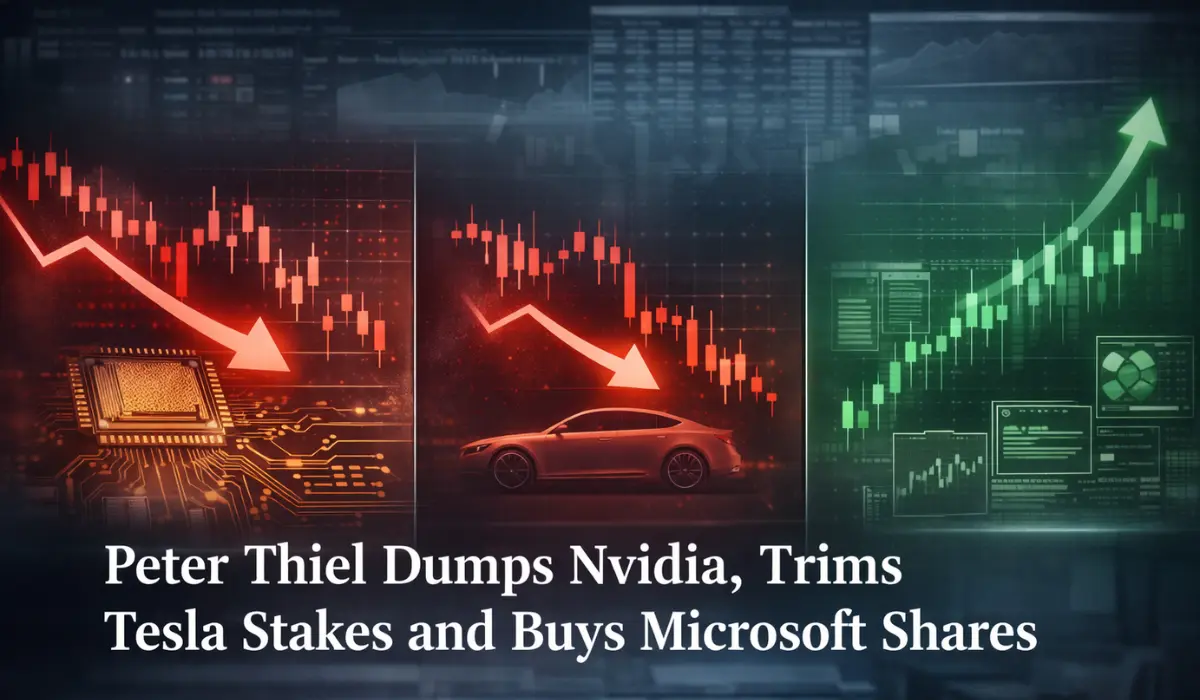
Billionaire investor and Palantir co-founder Peter Thiel has made a series of eye-catching portfolio moves that underscore his reputation as one of Silicon Valley’s most contrarian capital allocators. Recent regulatory filings reveal that Thiel has dramatically reshaped his public-equity exposure, selling out of high-flying names like Nvidia and sharply reducing his stake in Tesla, while initiating new positions in mega-cap technology leaders Microsoft and Apple. NVIDIA stock fell 0.54% to $186.10 at the close on Friday. Similarly, Tesla, Inc. (TSLA) slipped 0.23% to $437.52 in regular trading before climbing 0.70% after hours, highlighting mixed investor sentiment. However, Microsoft (MSFT) closed near record highs at $459.86 as optimism around its AI integration and Azure cloud growth continued.
The changes, made through regulatory filings from Thiel Macro LLC, suggest a deliberate shift in how the billionaire wants exposure to the artificial intelligence boom as markets head into 2026.
Exiting Nvidia as the AI Trade Crowds In
Perhaps the most striking move was Thiel’s complete exit from Nvidia, the dominant supplier of AI chips. According to filings, Thiel sold 100% of his Nvidia position, exiting roughly 537,000 shares valued at approximately $100 million. The sale came even as Nvidia continued to attract heavy inflows from institutional investors betting that demand for AI accelerators will remain insatiable.
Market analysts see the decision as classic Thiel. Known for exiting trades once they become “crowded,” Thiel appears to be stepping away from the hardware phase of AI, where expectations and valuation are already stretched. NVIDIA’s meteoric rise has made it one of the most widely owned stocks on Wall Street, a setup that contrarian investors often view as a risk rather than an opportunity.
Tesla Trim Signals Reduced Risk Appetite
Thiel also made a significant cut to his exposure to Tesla, another stock that has long been associated with disruptive innovation. Filings show that he sold approximately 76% of his Tesla shares, reducing his holding from around 272,000 shares to about 65,000 shares.
While Tesla remains a leader in electric vehicles and autonomous driving research, its stock has experienced heightened volatility amid concerns about pricing pressure, slowing EV demand growth, and increasing competition. The sharp reduction suggests Thiel is trimming cyclical and sentiment-driven exposure as he rebalances toward assets with more predictable cash flows.
Betting Big on Microsoft’s AI Ecosystem
Where Thiel exited risk, he also redeployed capital decisively. He initiated a new position in Microsoft (MSFT), which now accounts for roughly 34% of the fund’s assets, making it the dominant holding. While Microsoft is hardly a new name, its long-term performance is staggering: since its 1986 IPO, the stock is up nearly 460,000%, cementing its status as one of the most successful investments in modern market history.
Despite those gains, Thiel’s move signals confidence that Microsoft still offers compelling risk-adjusted returns. Analysts point to Microsoft’s deep integration with OpenAI and ChatGPT, along with the rapid expansion of its Azure cloud business, which has been posting growth rates north of 40%. In contrast to Nvidia’s hardware-centric story, Microsoft sits squarely in the application and platform layer of AI, where recurring revenue and software margins dominate.
Alongside Microsoft, Thiel also added a new position in Apple, describing it as a more defensive technology play. While Apple has been more measured in its AI messaging, its massive ecosystem, loyal customer base, and cash-generation capabilities make it a stabilizing force in a volatile tech landscape. However, Apple stock fell 1.05% to $255.52 at the close as investors weighed near-term valuation concerns, though the stock remains supported by its resilient ecosystem and long-term growth prospects.
A Broader De-Risking Strategy
Taken together, Thiel’s moves suggest a broader de-risking strategy rather than a retreat from AI itself. By rotating out of Nvidia and trimming Tesla, he is reducing exposure to crowded, high-beta trades. By piling into Microsoft and supplementing it with Apple, Thiel is signaling a belief that the next phase of AI wealth creation will favor software, cloud infrastructure, and real-world applications. As markets digest the evolving AI cycle, Peter Thiel’s latest portfolio reshuffle offers a clear message: even in a revolution as powerful as artificial intelligence, discipline, timing, and positioning still matter.


