

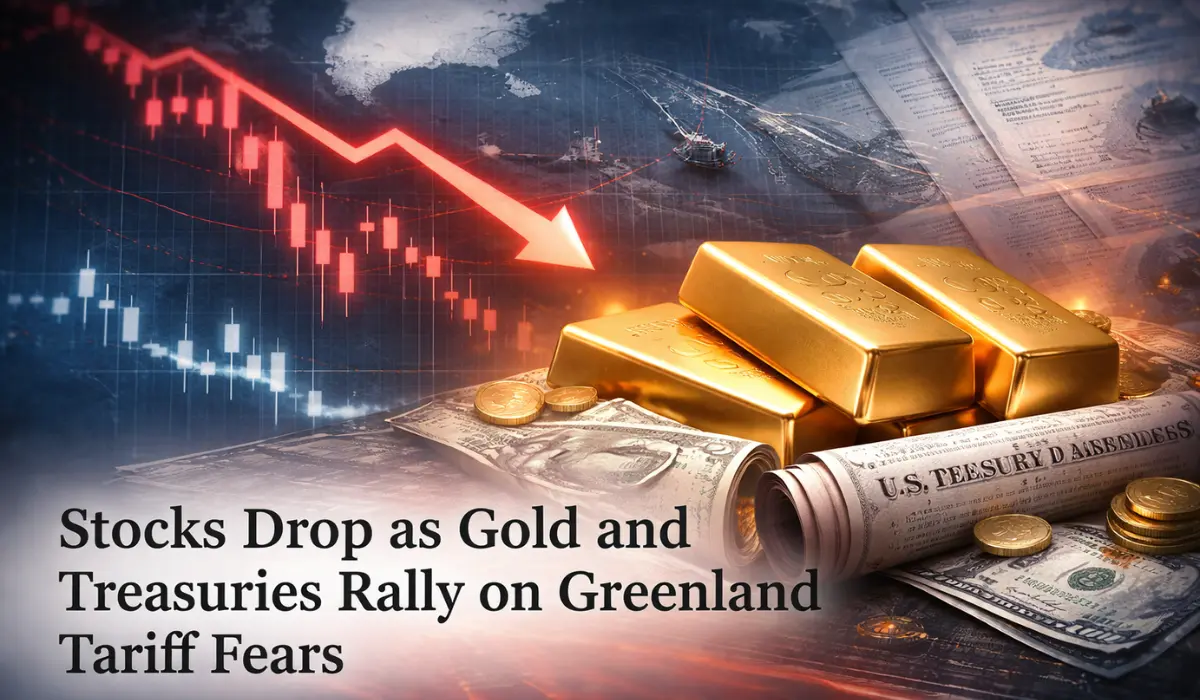
Following the US President Donald Trump’s announcement of imposing tariffs on eight European countries, the US and European stock prices have fallen, and the price of safe-haven assets such as gold has surged. US stocks declined, with the Dow Jones falling 1.2%, while the Nasdaq shed 2.1% on tech sector weakness. European indices mirrored the slide, with Switzerland’s SMI dropping by 1.8%.
Gold hit a record high near $2,900/oz, and 10-year treasury yields fell to 3.8%. This resulted in investors shifting toward gold, bonds, and the Swiss franc as equity benchmarks such as the S&P 500 dropped by over 1.5%. Asian markets slid to the lower edge amid the Greenland tariff concerns, while South Korean markets gained. The Chinese market showed mixed responses to the Greenland tariff concerns.
Context of Greenland Tariffs
US President Donald Trump had threatened the imposition of a 10% tariff on imports from eight European countries, namely Denmark, Norway, France, Germany, the Netherlands, Finland, and the UK, from February 1, 2026, if they refused to negotiate for the US acquisition of Greenland. Trump warned that the tariff rates would escalate to 25% by June 1 if no steps were taken by these countries in favor of the US.
The move was aimed at securing US control over Greenland’s strategic Arctic position and its vast mineral resources amid concerns over Chinese and Russian influence. Trump’s move is despite a 1951 treaty already granting the US military rights over Greenland.
The tariff threats were vehemently opposed by the European countries. European leaders issued a joint statement rejecting the threats as risking a “dangerous downward spiral”. Danish PM Mette Frederiksen declared that Europe “will not be coerced” by Trump’s tariff announcements. French President Emmanuel Macron called tariff intimidation “unacceptable,” vowing a united EU response to protect their sovereignty. The EU officials are preparing a retaliatory €93bn tariffs on US goods ahead of the Davos discussions.
Greenland Tariffs’ Impact on Global Supply Chains
Tariffs on European countries opposing US control of Greenland could disrupt global supply chains by raising the costs of key exports such as industrial machinery, chemicals, and autos from nations including Germany, France, and Denmark. Companies reliant on these flows might face immediate price hikes of 10-25%. This will force stakeholders to reroute imports through intermediaries like Southeast Asia, delay shipments, and increase logistics expenses. Rare earth minerals and defense tech stand out as the most affected areas, as Greenland holds 1.5 million tons of critical elements vital for EVs, renewables, and semiconductors.
Market analysts have predicted that it would be difficult for the US and the EU-based actors to compete with the Chinese dominance if the US does not reconsider its decision to impose tariffs. To overcome this conundrum, European exporters may pass the extra costs incurred to the US consumers, sustaining inflation. Moreover, EU retaliation targets $108-€93 billion in American goods like agriculture and aircraft, which is also likely to cause an impact on the global market.


