

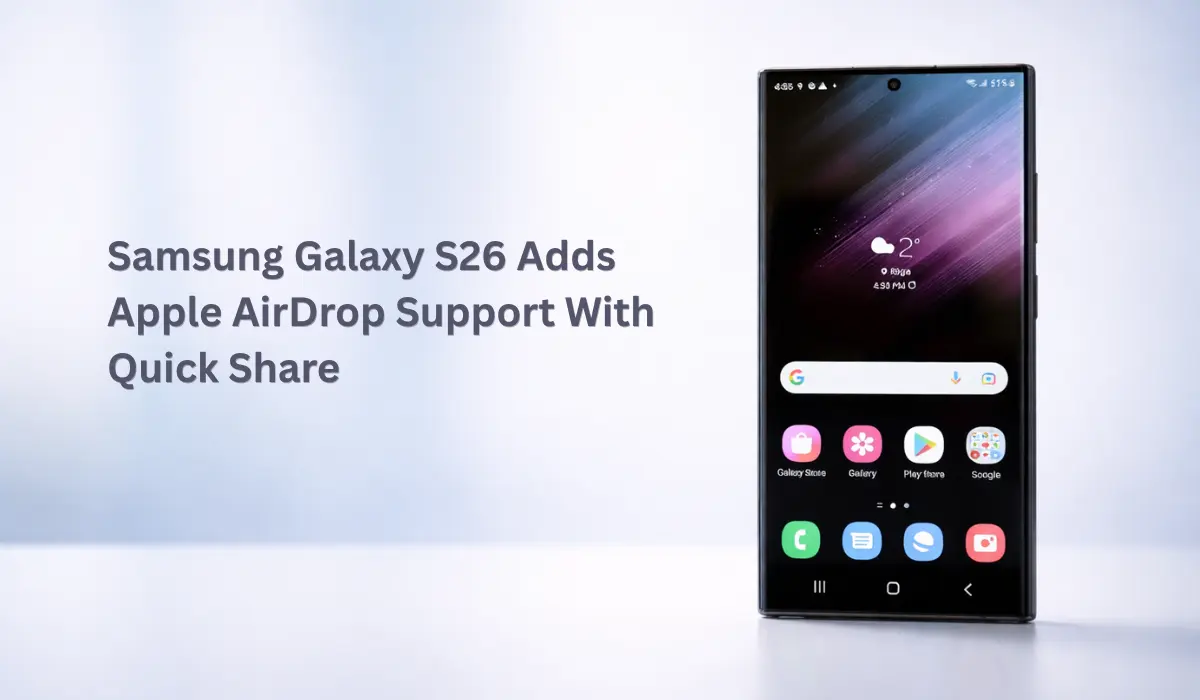
Samsung Electronics has announced a landmark update bringing cross-platform compatibility between its Quick Share service and Apple’s AirDrop. Launching exclusively on the new Samsung Galaxy S26 series, this integration bridges the long-standing gap between the iOS and Android “walled gardens,” allowing the seamless transfer of high-resolution media between rival devices.
A Long-Awaited Win for Galaxy Users
This announcement marks a diplomatic victory for Samsung users. Through this integration, Galaxy owners can finally use Quick Share to exchange high-resolution media directly with Apple devices. For years, users have been relying on third-party apps, cloud links, or messaging platforms that often compress files and degrade quality.
In a formal statement released on Monday, March 23, 2026, a Samsung representative explained, “We have maximized user convenience by helping Galaxy users communicate seamlessly with users of devices running on other operating systems.”
This rollout follows a teaser from Choi Won-joon, President and COO of Samsung’s Mobile Experience business, who hinted at the move during a press conference in Japan last week. At the time, Choi stated: “We plan to support AirDrop compatibility starting with the Galaxy S26 series,” confirming that the new flagship lineup would serve as the bridge for this cross-platform leap.
The DMA Factor
The key driver behind this sudden era of cooperation between long-time rivals isn’t just a shift in corporate philosophy; it is part of legal pressure from the European Union. The Digital Markets Act (DMA), designed to curb the power of tech “gatekeepers,” has forced Apple to open its ecosystem in ways previously thought impossible. In a press release published on March 19, 2025, exactly one year before this rollout, the European Commission announced two landmark decisions under the Digital Markets Act (DMA).
According to the Commission, interoperability is the key to unlocking new opportunities for third-party developers, allowing them to build innovative products and services directly on Apple’s “gatekeeper” platforms. This shift facilitates a deeper, more seamless integration of third-party hardware within the Apple ecosystem. The initial rollout includes nine iOS connectivity features, specifically targeting faster data transfers through peer-to-peer Wi-Fi and NFC, as well as simplified device pairing. Consequently, connected devices from any brand will now function more effectively alongside iPhones.
While the EU’s focus lies primarily on the European market, these regulations have triggered a significant global effect. By forcing Apple to be interoperable, the DMA has effectively paved the way for Apple to collaborate with Google Pixel and its biggest rival, Samsung.
The Road Ahead
Currently, this groundbreaking feature is limited to the Galaxy S26 series, which was officially launched earlier this month. As a software-dependent feature, a wider rollout for older flagships, including the Galaxy S25 and S24 series, is expected to follow in upcoming One UI updates later this year.
This update addresses a long-standing pain point for Samsung users by finally providing a seamless way to communicate with the iOS ecosystem without sacrificing file quality or security. By removing one of the last major barriers to switching between platforms, Samsung expects this new feature to further drive sales and strengthen its position in the competitive North American market.


