

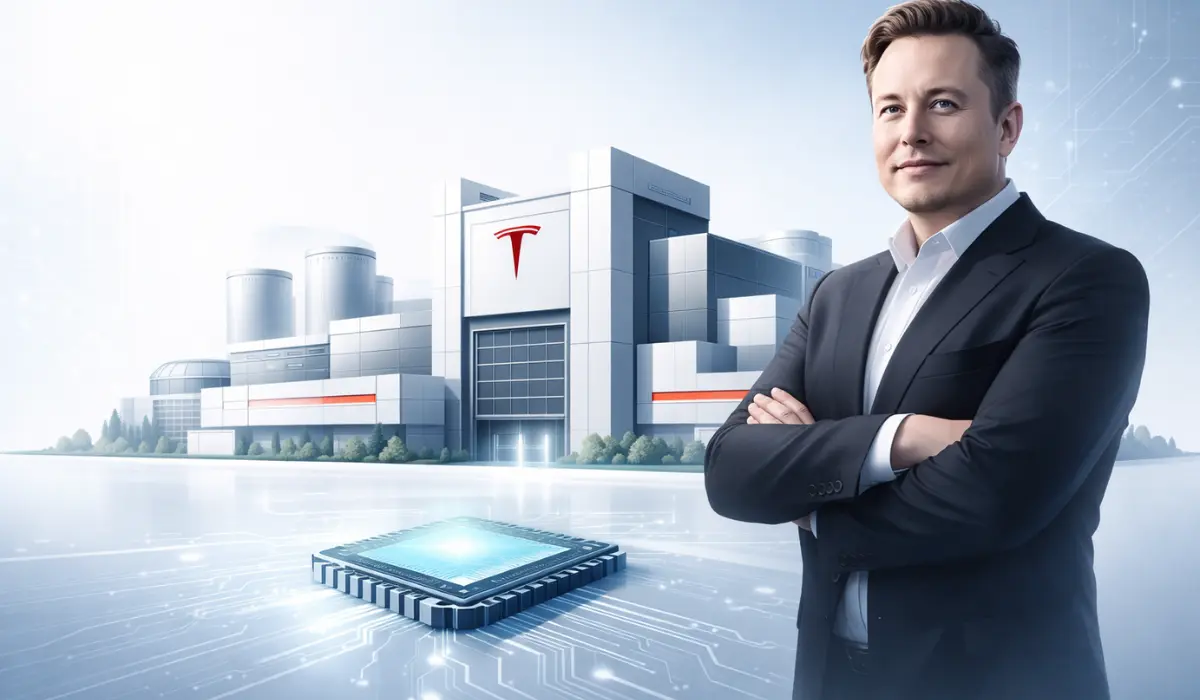
Elon Musk revealed the Tesla Terafab project, a major expansion plan of the company, on March 21, 2026, during a theatrical event inside Austin’s defunct Seaholm Power Plant. Launching the project, Musk mentioned Terafab as part of the company’s broader strategy to establish domestic chip manufacturing in the US while reducing dependency on overseas manufacturers.
The latest reveal marks a strategic pivot in the company’s history, while investors are grappling with how Tesla could afford this ambitious expansion plan without straining its tight capital position.
Tesla’s Terafab: A $25 billion Moonshot to Bet on the Future of AI and Chip Manufacturing
Elon Musk made a formal announcement of the Terafab project on the X platform and officially unveiled it on the night of March 21, 2026, with high-intensity light beams shooting into the Texas sky. Musk announced that the project will be jointly managed by Tesla and SpaceX to deliver next-generation AI chips in-house.
According to Musk, the project will be an ultimate solution addressing the critical semiconductor shortages for robotics applications and AI. Before scaling up, the Terafab facility will initially commence its operations as the Advanced Technology Plant in Austin, which will have all the key equipment to design, manufacture, and test the chips. The next stage of Terafab is to propel a full-fledged production cycle that is capable of fabricating, testing, and deploying the chips across space data centers, AI, and robotics.
Tesla’s Bold Responses to Supply Chain Bottlenecks
The multi-billion-dollar project, Terafab, is Musk’s response to the critical supply chain bottlenecks that impair production operations. Currently, the company is heavily reliant on major suppliers, including Micron Technology, Samsung Electronics, and TSMC, for advanced chips that power AI and robotics. Musk warned that the surging demand from robotics, AI, and autonomous driving may soon tighten the supply of semiconductors in the coming year, obstructing the scale of production. The Terafab project is a step towards full vertical integration, a bigger move by Elon Musk to foster in-house production of chips and protect the company from unpredictable supply chain risks.
Too Big to Achieve? Massive Plans and Production Targets Revealed
The production targets of Tesla are highly ambitious, with plans to produce 100-200 billion chips and memory chips using 2nm technology. Currently, TSMC is the only company to have achieved large-scale 2nm production, which required decades of development and significant R&D investment. Terafab is aiming to handle 100,000 chips monthly and mass production of AI5, which is expected to begin by mid-2027. While the vision and goals of Terafab are futuristic and massive, the stringent timeline and technical expectations make it hard to achieve in the near term.
Terafab 80-20 Rule — Space vs. Earth
Musk introduced Terafab, the in-house chip manufacturing plan, as a joint venture between Tesla and SpaceX. Terafab will produce inference chips for Optimus robots and Tesla vehicles and D3 chips for orbital AI satellites. The compelling part of the announcement is the ‘Space Computing’ vision, with Musk allocating 80% of Terafab’s output to orbital AI satellites and the remaining 20% to Tesla’s ground-based applications. Stating the 80-20 rule, Musk argued that orbital AI computing would become cheaper than terrestrial alternatives in the upcoming years.
Can Tesla afford its Ambitious AI and Chip Expansion?
The estimated cost of the Terafab project is $25 billion, raising investor concerns centered on the aggressive capital spending of the company. Establishing an in-house chip supply is a strategic triumph, but for investors, Tesla’s ‘zero-to-2nm’ moonshot is a high-stakes gamble into a specialized industry where even the incumbents struggle to execute.
Tesla’s previous setbacks in battery scaling, marked by delays and costly write-downs, now cast a shadow of skepticism over Tesla’s latest $25 billion chip-making moonshot. With Tesla already committing over $20 billion to existing growth plans, this new initiative will significantly escalate capital expenditure, fueling skepticism over the company’s financial ability to yield the promised results.


