

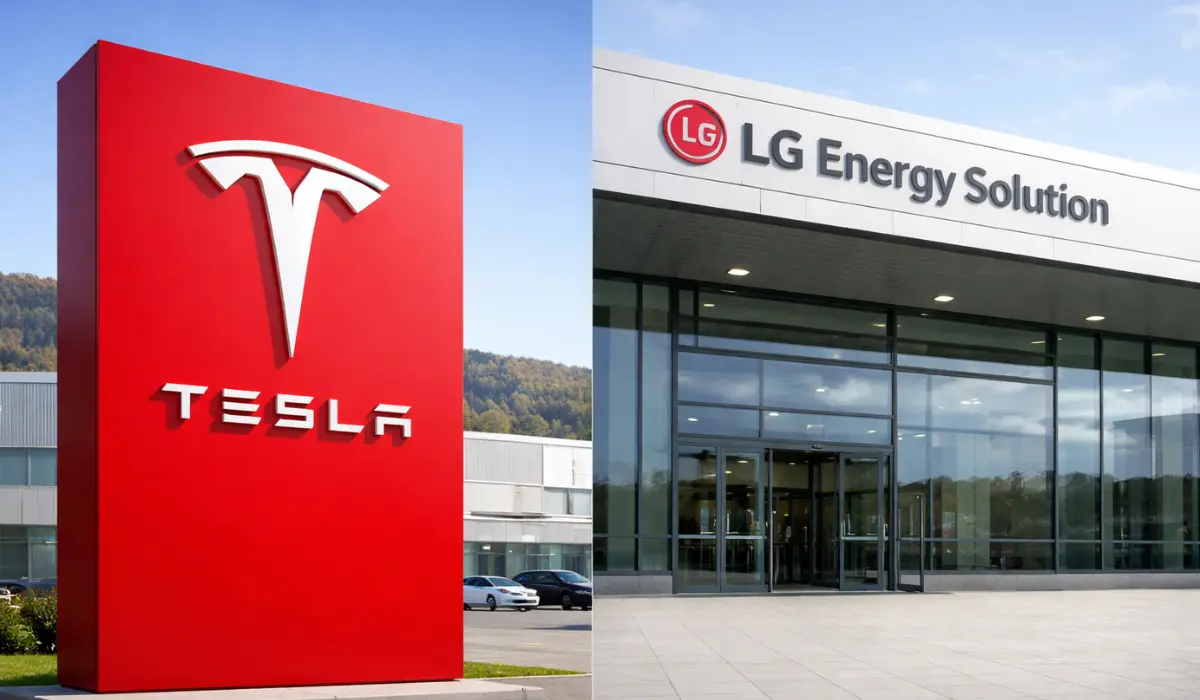
During the Trump Administration’s Indo-Pacific Energy Security Summit on March 16, 2026, tech giant Tesla confirmed the much-anticipated deal with LG Energy Solution for the production of $4.3 billion worth of battery cells, thereby strengthening its stronghold within the high-demand field of energy storage.
The agreement for domestic production of energy storage systems for Tesla’s Megapack 3 comes during a time when the company faces tariff threats on the import of Chinese lithium iron phosphate (LFP) battery cells, critical to Tesla’s energy storage division. The domestic LFP battery supply is projected to pave the way for Tesla’s recovery from previous hindered growth, giving a future-proof leverage to the U.S. and promoting a bullish narrative for the long-term.
The domestically produced cells are scheduled to begin powering Megapack 3 systems in August 2027.
Insulating the Supply Chain: A Shield Against Tariff Volatility
Tesla’s energy storage division is the company’s only segment that has delivered consistent growth since its inception. The success and revenue generated by the energy department are key to Tesla’s sustenance. However, this is also the department that is facing imminent, direct threats on tariffs during the ongoing geopolitical crisis, as it is highly dependent on the LFP cells sourced from China.
In 2024, the U.S. raised tariffs on Chinese lithium-ion EV batteries. These tariffs were part of the move to reduce dependency on Chinese supply chains, while protecting domestic industries and promoting energy sustainability within the nation. In 2025, Chinese LFP cells face tariffs as high as 82.4%, which consequently turns Tesla’s prized international asset into a liability.
The U.S. Department of the Interior announced that,
“American-made cells will power Tesla’s Megapack 3 energy storage systems produced in Houston, creating a robust domestic battery supply chain.”
The agreement with LG Energy Solution positions LG as the only major battery supplier currently scaling US-based LFP production, ahead of industry competitors like Samsung SDI and SK On.
LG & Tesla Repurpose the Lansing Plant for LFP
The U.S. project to produce domestically made LFP cells will begin at LG Energy Solution’s Lansing plant in Michigan. The plant was initially used to produce Ultium Cells 3 for General Motors and is now under the complete ownership of LG, after GM sold its stake to LG in May 2025.
The plant will require changes in its infrastructure to incorporate battery production, with LG already placing equipment orders. The contract between Tesla and LG starts in August 2027, with mass production of LFP prismatic cells expected in the second half of 2027. The project will continue through July 2030, with a leeway to extend the duration or increase the volume.
Megapack 3: Tesla’s Industrial-Scale Energy Storage
LG Energy Solution’s domestically produced LFP cells will power Tesla’s industrial-grade energy storage product, the Megapack 3, which is designed to improve efficiency, capacity, and supply chain security. The use of U.S.-produced cells allows Tesla to reduce reliance on Chinese imports while potentially qualifying for U.S. tax incentives.
Unveiled in September 2025, the next-generation Megapack is designed to boost energy storage capacity from 3.9 MWh (as in Megapack 2) to roughly 5 MWh per unit. This is achieved by using larger, 2.8-liter LFP cells, where each unit stores more energy in a similarly sized container. Tesla also drastically simplified the cooling and heating system, reducing connections by 78%, minimizing leak points, and shortening manufacturing and installation times.
Manufacturing the Megapack 3 is scheduled for late 2026 at Tesla’s Houston Megafactory. The facility aims for an annual production capacity of 50 GWh.
What to Expect in Tesla’s Future
The $4.3 billion partnership between LG Energy Solutions and Tesla for the domestic production of LFP cells insulates Tesla’s energy storage division from the increasing uncertainty regarding tariff volatility on Chinese battery cell imports. The deal secures U.S.-made cells for the upcoming Megapack 3, designed to boost efficiency, while capitalising on domestic production.
Reducing dependency on international supply strengthens national production, ensuring Tesla’s long-term growth in a future that will witness high demand and supply shortages within the field of energy storage and supply.


