

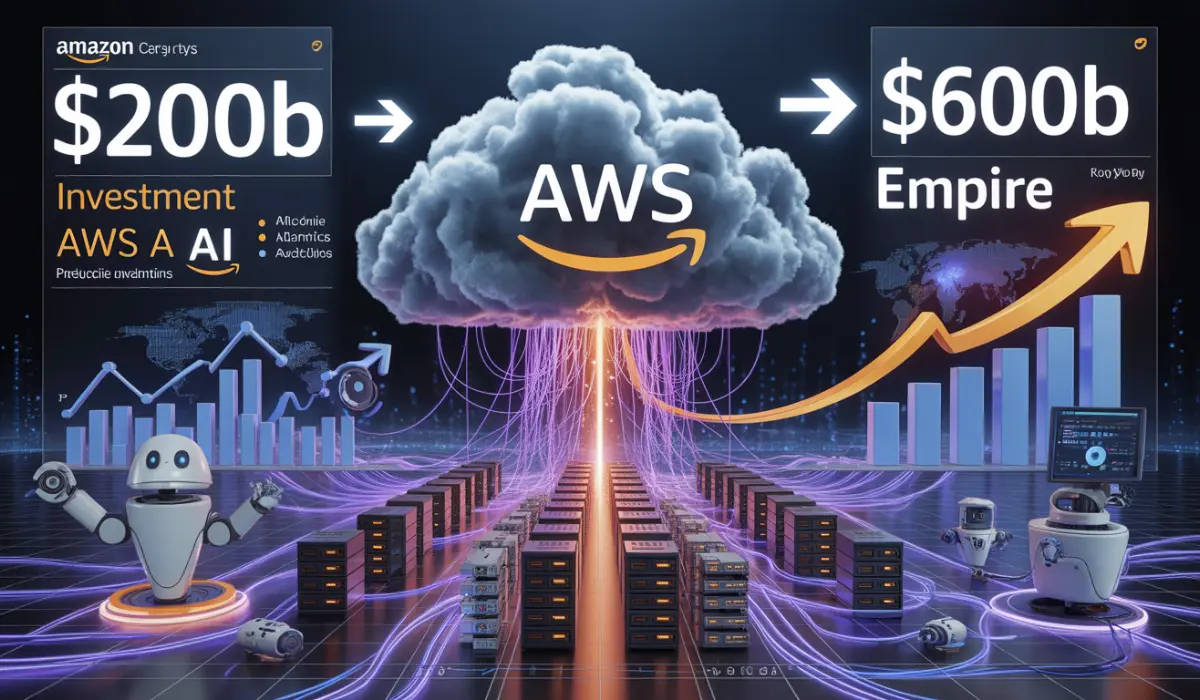
In a move that has sent ripples through Silicon Valley and Wall Street, Amazon CEO Andy Jassy has significantly raised the stakes for the company’s cloud computing future. During an internal all-hands meeting on Tuesday, March 17, 2026, Jassy predicted that Amazon Web Services (AWS) could reach an annual revenue run rate of $600 billion within the next decade, doubling his previous long-term forecast.
Jassy framed the opportunity as “unusual,” pointing to the rapid adoption of generative AI tools across industries. Rather than treating AI as a feature layered onto cloud computing, Amazon is positioning AWS as the foundational infrastructure powering what it believes will be the next era of computing.
The Numbers Behind the Ambition
The scale of the target becomes clearer when measured against AWS’s current position. In 2025, AWS generated $128.7 billion in revenue, marking a healthy 19% year-over-year increase. To reach $600 billion within roughly a decade, the business would need to sustain a compound annual growth rate of about 17%, a demanding but not unprecedented pace in the cloud sector.
What makes AWS especially critical is not just its size, but its profitability. While it contributes roughly 17-18% of Amazon’s total revenue, it accounts for an estimated 60% of operating profit. In effect, AWS is the financial backbone of Amazon, subsidizing investments across retail, logistics, and emerging technologies.
That dynamic raises the stakes. If AWS succeeds in scaling to Jassy’s target, it could redefine Amazon’s valuation. If it falls short, the ripple effects could be felt across the entire company.
Betting Big on AI Infrastructure
Realizing this vision requires more than just optimistic projections; it demands an unprecedented level of capital investment. Amazon is planning to pour approximately $200 billion into capital expenditures in 2026 alone, a figure that dwarfs most of its peers and underscores the long lead times required to secure data center space, specialized chips, and the staggering amount of power needed to run AI workloads.
Central to this strategy is Amazon’s move to decouple itself from a total reliance on third-party hardware. While the company continues to purchase vast quantities of Nvidia GPUs, it is increasingly pushing its own custom-designed AI silicon to gain a competitive edge. This includes Trainium, specialized chips engineered specifically for the high-intensity training of massive machine learning models, and Graviton, the ARM-based processors that provide superior price-performance ratios for general-purpose cloud workloads.
By vertically integrating its hardware, Amazon aims to offer a significant cost advantage that could become the deciding factor for enterprises weighing AWS against Microsoft Azure or Google Cloud. This proprietary infrastructure serves as the foundation for a growing suite of high-level AI services, most notably Amazon Bedrock, which allows developers to build generative applications using a diverse range of foundational models, including Amazon’s recently expanded Nova family.
The strategy also includes a significant push into the public sector. In a notable shift, Amazon recently announced a partnership with OpenAI to deliver specialized AI services to the U.S. government via AWS. Combined with nearly $50 billion in dedicated government cloud investments, Amazon is positioning itself as the primary secure gateway for federal and defense-related AI applications.
Market Sentiment and the Competitive Horizon
The market’s reaction to this spending spree has been a study in cautious optimism. When the $200 billion capex figure was first signaled during earnings calls, Amazon shares saw a temporary dip as investors questioned the near-term impact on margins. However, the stock has since stabilized, up roughly 1% in recent trading sessions, as clearer signals of AI demand began to emerge from the enterprise sector.
The competitive landscape remains fierce. AWS currently maintains a 30% share of the global cloud market, but its lead is under pressure. Microsoft Azure (holding ~21%) and Google Cloud (~14%) have shown faster percentage growth in recent quarters, often leveraging their own AI breakthroughs, specifically Microsoft’s early lead with OpenAI’s consumer-facing tools. Jassy’s gamble is that AWS’s incumbency and its “One Amazon” ecosystem will eventually provide a more robust platform for enterprise-grade AI than its competitors’ more consumer-centric approaches.
Operational Synergies: AI Beyond the Cloud
While AWS serves as the primary financial engine, the company’s AI strategy is increasingly woven into its broader operational fabric. During the meeting, Jassy highlighted how artificial intelligence is being deployed to solve complex physical and logistical challenges, moving beyond digital services into the real world. A key milestone in this effort is the company’s drone delivery program, which is on track to complete its one millionth delivery by late 2026. This achievement marks a significant scale-up for the Prime Air service, which only recently began widespread commercial testing in select U.S. markets.
On the retail side, the Rufus AI shopping assistant has already surpassed 300 million users, fundamentally changing how consumers discover products on the platform. These successes provide a stark contrast to some of Amazon’s more traditional retail experiments; the Amazon Fresh and Go stores continue to struggle, holding less than 1% of the U.S. grocery market share. This disparity suggests that Amazon’s greatest future strengths lie not in physical storefronts, but in the invisible AI layers that optimize logistics and digital discovery.
The Utility Layer of the AI Era
Andy Jassy is essentially betting the house that AI is not a fleeting trend, but the new foundational utility of the modern economy. By aiming for $600 billion, he is positioning AWS as the indispensable backbone of that utility.
The coming years will determine if this massive capital outlay was a visionary land grab or an overextension. Can AWS sustain 17% growth as it approaches the half-trillion-dollar mark? Will the energy constraints currently facing data center expansion stifle these ambitions? While the risks of an AI market correction are real, Amazon’s strategy makes one thing clear: the company is no longer just selling compute power; it is selling the future of intelligence itself.


