

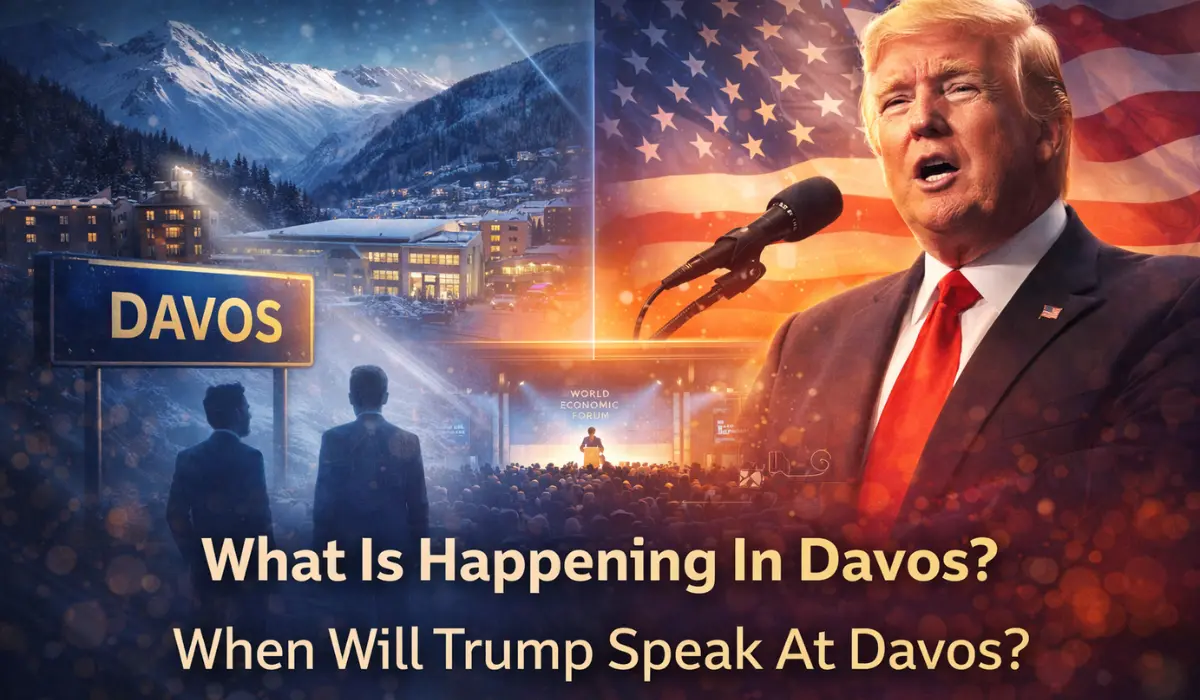
Today, January 20, 2026, marks the second official day of the 56th World Economic Forum (WEF) Annual Meeting in Davos, Switzerland, and the mood inside the Alpine resort is notably tense. While the World Economic Forum traditionally serves as a platform for cooperation and long-term economic planning, this year’s gathering is unfolding under the shadow of escalating geopolitical uncertainty, much of it centered on U.S. President Donald Trump and his tariff threats on European countries over Greenland.
A Davos Defined by Trump Even Before He Speaks
Although Donald Trump is not scheduled to speak today, his presence is already being felt across nearly every panel and closed-door meeting. Global leaders are reacting to two closely linked developments from Washington: renewed U.S. efforts related to the acquisition of Greenland, and the announcement of new tariffs on European allies.
The Greenland issue has emerged as the central geopolitical flashpoint of the 2026 summit. What began as a strategic conversation has evolved into a broader debate over sovereignty, security, and the future of transatlantic relations. In Davos, Switzerland, diplomats privately describe the issue as a stress test for the post-Cold War global order.
With Trump absent today, the spotlight has shifted to Europe’s leadership. Ursula von der Leyen, President of the European Union (EU) executive, “Geopolitical shocks can – and must – be an opportunity for Europe,” she said at Davos.
When Will Trump Speak at Davos?
Trump is expected to arrive in Davos later today or early tomorrow, January 21. Trump is also expected to participate in a separate housing initiative discussion later on January 21 or 22, though the exact timing has not yet been confirmed.
Before his visit, he had shared private messages sent to him by European leaders. Mark Rutte said that what the president had accomplished in Syria that day was incredible. He added that he would use his media engagements in Davos to highlight the president’s work in Syria, Gaza, and Ukraine, and said he was committed to finding a way forward on Greenland. He concluded by saying that he was looking forward to seeing him.
Moreover, Emmanuel Macronwrote in a private message, “I can set up a G7 meeting after Davos in Paris on Thursday afternoon. I can invite the Ukrainians, the Danish, the Syrians, and the Russians in the margins.”
Beyond Geopolitics, AI Remains Dominant
Beyond geopolitics, Artificial Intelligence remains a dominant topic for business leaders at the World Economic Forum. CEOs are discussing productivity gains, regulation, and the race between the U.S., Europe, and Asia to control next-generation AI infrastructure. Yet even these conversations are increasingly framed through a geopolitical lens.
J.P. Morgan CEO Jamie Dimon and Nvidia CEO Jensen Huang are among the high-profile, influential corporate executives and technology pioneers converging on Davos, underscoring the summit’s role as a global crossroads of power, policy, and innovation.
The “Spirit of Dialogue” Tested
The official WEF theme emphasizes cooperation and what organizers call the “Spirit of Dialogue.” However, critics argue that this spirit is being overshadowed by the Greenland crisis and looming tariff battles. Until Donald Trump takes the stage tomorrow, Davos remains in a holding pattern, listening, reacting, and waiting for the remarks that could define not just the rest of the summit, but the global economic narrative of 2026.


