

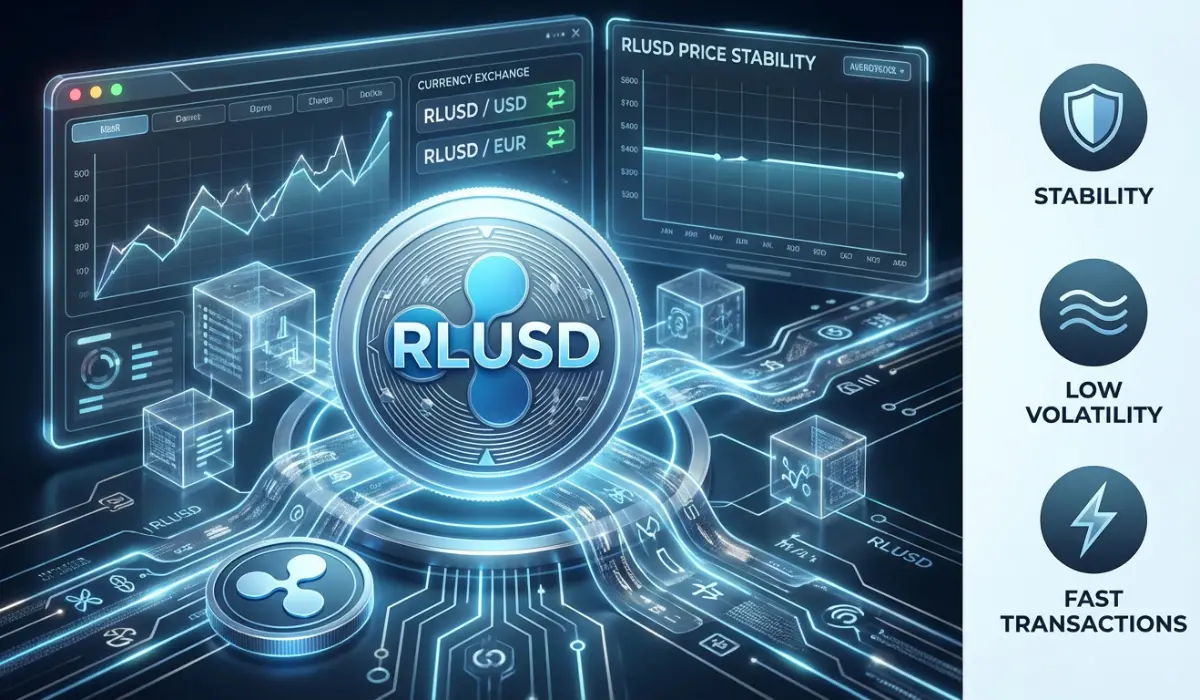
The count of stablecoins in the crypto landscape is rapidly increasing each day, fueled by growing demand for reliable digital tokens that maintain a stable value compared to traditional fiat currencies, like the US dollar. The main players, such as USDC (USD Coin) and USDT (Tether), dominate the market, but new stablecoins, like Ripple’s RLUSD, are gaining traction in recent days, mainly on high-liquidity platforms like ETH (Ethereum).
Ripple USD (RLUSD) is a USD-backed stablecoin, maintaining a 1:1 value with the U.S.Dollar via reserves of money, treasuries of the United Kingdom, and other cash equivalents built by BNY Mellon. RLUSD was launched in December 2024 by Brad Garlinghouse and Monica Long, who serve as the CEO and president of Ripple Labs. In this guide, we can explore the potential features of Ripple’s RLUSD. Let’s delve into it.
Working Mechanism of RLUSD
RLUSD follows the mint-and-burn mechanism, where new digital assets are published only when a similar count of U.S. dollars is deposited. It operated based on the 1:1 peg, which means every digital token in circulation and exactly one U.S. dollar held in reserve. The core elements that highly support the technical and operational integrity of the working mechanism of RLUSD are Reserve management, Issuance, and Transparency.
Standard Custody & Trust Company, a New York-based, Ripple acquired financial tech company that holds a New York Trust Charter, issued Ripple USD (RLUSD). Further, its reserves are held by an authorized custodian under the oversight of the NYDFS (New York Department of Financial Services).
The reserves of RLUSD include cash equivalents, U.S.Dollar deposits, and short-term Treasuries. All are held by the world’s highest custodian banks, called BNY Mellon.
Ripple employs the accounting company BPM to carry out monthly 3rd party audits and attestations, ensuring trust and proving that the stablecoin is completely collateralized. Moreover, the multichain integration of the Ripple platform strengthens seamless movement of RLUSD among networks designed for cost and speed proficiency.
How to Purchase Ripple USD (RLUSD)
Users can purchase RLUSD through various methods based on their preference for security, convenience, and available payment options. Ripple USD (RLUSD) has built a high liquidity network to ensure that this stablecoin is simply available to both institutional users and retailers. To purchase Ripple USD (RLUSD), users need to strictly follow the instructions below.
- Step 1
The initial step is to select a reliable and supported exchange platform that effectively operates in your jurisdiction. Some of the popular examples include MoonPay, Uphold, Independent Reserve, Bitstamp, Bullish, Bitso, and CoinMENA.
- Step 2:
The next step after selecting a reliable exchange platform is account verification. To do this, users need to register their accounts on the selected platform using their mobile number and email ID, and then complete the KYC procedures. To provide additional security, you need to set a strong password for your account and also complete the 2FA process.
- Step 3:
After account registration, the next step is to deposit funds. To deposit money, you need to choose supportive payment methods such as cryptocurrency, bank transfer, and credit /debit card options. Despite these payment methods, initially, you need to purchase a compatible stablecoin like USDC or USDT to purchase RLUSD from the selected exchange platform.
- Step 4:
You can purchase Ripple USD (RLUSD) in two ways: via direct purchase or through a decentralized exchange platform (DEX). In a direct purchase, you need to choose RLUSD from the token list. Then enter the needed amount and confirm the purchase. On the other side, to purchase RLUSD through DEX, you need to swap your stablecoin for RLUSD associated with the trading interface of the selected DEX platforms.
Step 1: The initial step is to select a reliable and supported exchange platform that effectively operates in your jurisdiction. Some of the popular examples include MoonPay, Uphold, Independent Reserve, Bitstamp, Bullish, Bitso, and CoinMENA.
Step 2: The next step after selecting a reliable exchange platform is account verification. To do this, users need to register their accounts on the selected platform using their mobile number and email ID, and then complete the KYC procedures. To provide additional security, you need to set a strong password for your account and also complete the 2FA process.
Step 3: After account registration, the next step is to deposit funds. To deposit money, you need to choose supportive payment methods such as cryptocurrency, bank transfer, and credit /debit card options. Despite these payment methods, initially, you need to purchase a compatible stablecoin like USDC or USDT to purchase RLUSD from the selected exchange platform.
Step 4: You can purchase Ripple USD (RLUSD) in two ways: via direct purchase or through a decentralized exchange platform (DEX). In a direct purchase, you need to choose RLUSD from the token list. Then enter the needed amount and confirm the purchase. On the other side, to purchase RLUSD through DEX, you need to swap your stablecoin for RLUSD associated with the trading interface of the selected DEX platforms.
Step 5: After purchasing the RLUSD, the next step is to store the RLUSD securely in a compatible wallet that supports the Ethereum or XRP ledger. To prevent financial loss, you should enable security measures and backup recovery phrases.
By efficiently following the above step-by-step instructions, you can get safe access to Ripple USD (RLUSD) while ensuring safety and flexibility in handling your digital assets.
Ripple USD (RLUSD) Use Cases
Ripple USD (RLUSD) is primarily framed for a variety of financial applications, primarily focusing on international trade settlement and cross-border payments. RLUSD is not just a store of value but an efficient tool for high-speed utility.
Cross-border payments: RLUSD offers a stable digital currency that enhances payment methods and decreases volatility. Further, it enables availability around the clock without any banking hour restrictions and also supports transparent tracking via blockchain transaction records.
International Remittances: One of the key use cases of Ripple USD (RLUSD) is to facilitate international remittances, where this stablecoin provides a reliable, fast, and low-cost option for migrant workers to transfer their funds.
Tokenization of RWA (Real World Assets): RLUSD serves as the settlement stage for tokenizing assets like commodities, government bonds, and real estate.
Decentralized Finance (DeFi): RLUSD also supports the use cases of the Decentralized Finance (DeFi), such as trading and lending, especially via collaboration with the built-in DEX of XRP Ledger, and features of Mult-purpose Tokens and auto bridging. Similarly, RLUSD is also used for the yield farming around multiple chains, such as Optimism and Base, with the help of Wormhole’s NTT technology.
Institutional Finance: For institutions, RLUSD serves as collateral and a settlement tool, which helps the firms to settle trades, post collateral, and unlock liquidity around blockchain-based platforms.
Pros and Cons
The Pros and Cons of the Ripple USD (RLUSD) are listed below.
| Pros | Cons |
|---|---|
| Minimize Price Volatility | Compared to USDT, less initial trading volume |
| Mainly designed for low-cost, quick, remittance, and cross-border payments, | RLUSD is pointed out to central freezing power as like all other fiat-backed stablecoins. |
| Backed by Advisory Board: David Puth and Sheila Bair. | High Competition from |
| Beginner friendly | Difficulties in cross-chain swaps may need well-regulated bridges as well as well-established stablecoins. |
| Efficiently enables cross-border payments. | It’s purely a stable asset and has no efficiency for price appreciation. |
Is RLUSD Better Than USDT? Comparison with Other Stablecoins
Stablecoins are digital tokens, and their main benefit is that they offer price stability even in the highly volatile cryptocurrency landscape. In terms of transparency and regulatory compliance, RLUSD implies a compelling substitute to USDT. USDT sustains dominance for DeFi usage, general investment, and trading because of liquidity, widespread adoption, and multi-chain presence. RLUSD is better for users who continuously communicate with the XRP Ledger, and it obtains a stablecoin with high regulatory transparency in a certain landscape.
Regarding long-term security and wide adoption around platforms, USDC or USDT still dominate in the market. Similarly, USDT is also a market leader in terms of liquidity and market capitalization. While analysing the case of RLUSD, it is ensuring niche use cases and could show adoption rises if the strategy of Ripple becomes successful.
USDT encountered an ongoing examination over regulatory concerns and reserve transparency. RLUSD works under the NYDFS Limited-purpose trust charter, which is one of the most significant regulatory frameworks for stablecoins. Similarly, RLUSD is completely backed by cash equivalents, U.S.dollar deposits, and government bonds, which follow a 1:1 peg with the U.S.dollar.
USDT is mainly utilised for liquidity across exchanges, crypto trading, and DeFi, and its major benefits involve multi-chain integration, high liquidity, cross-platform use, and widespread adoption.
However, when analysing the features of RLUSD, USDT, and other stablecoins, it was not that RLUSD is unique when compared to others, as it is optimized for the Ripple payments network, whereas others are utilised for general purposes. Likewise, when compared to other stablecoins, RLUSD is “better” based on certain use cases of users, such as broad trading and liquidity versus remittances and payments.
Future of Ripple USD (RLUSD)
Ripple USD (RLUSD) is poised for high growth in 2026, fueled by institutional adoption, regulatory compliance, and chain expansion. Ripple is expanding RLUSD to additional blockchains, including distinct Ethereum Layer-2s and Cardano.
When analysing market analytics and technical analysis, RLUSD estimates a bearish trend in the near future. These results imply that Ripple USD might not be the best option for short-term investment, but it is good for long-term investors because it estimates a gradual rise in value, especially reaching $1.05-$1.28 between 2026 and 2031.
Despite these market sentiments, according to the 2026 conditional approval from the OCC, Ripple USD (RLUSD) is growing higher to become a bank-aligned stablecoin, especially treated as a major settlement digital asset for global institutional forex trades and CBDC (Central Bank Digital Currency) pilots.
Bottom Line
In the stablecoin market, RLUSD signifies an important shift from speculation to standardization, with a strong emphasis on regulatory compliance and institutional adoption over instant retail uplift. Ripple has built a digital dollar that companies can trust by assimilating the speed of the XRP ledger with the regulatory oversight of the New York Department of Financial Services. As far as now, Ripple USD (RLUSD) represents an addition to the developing landscape of digital stable currencies, shifting international finance.


