

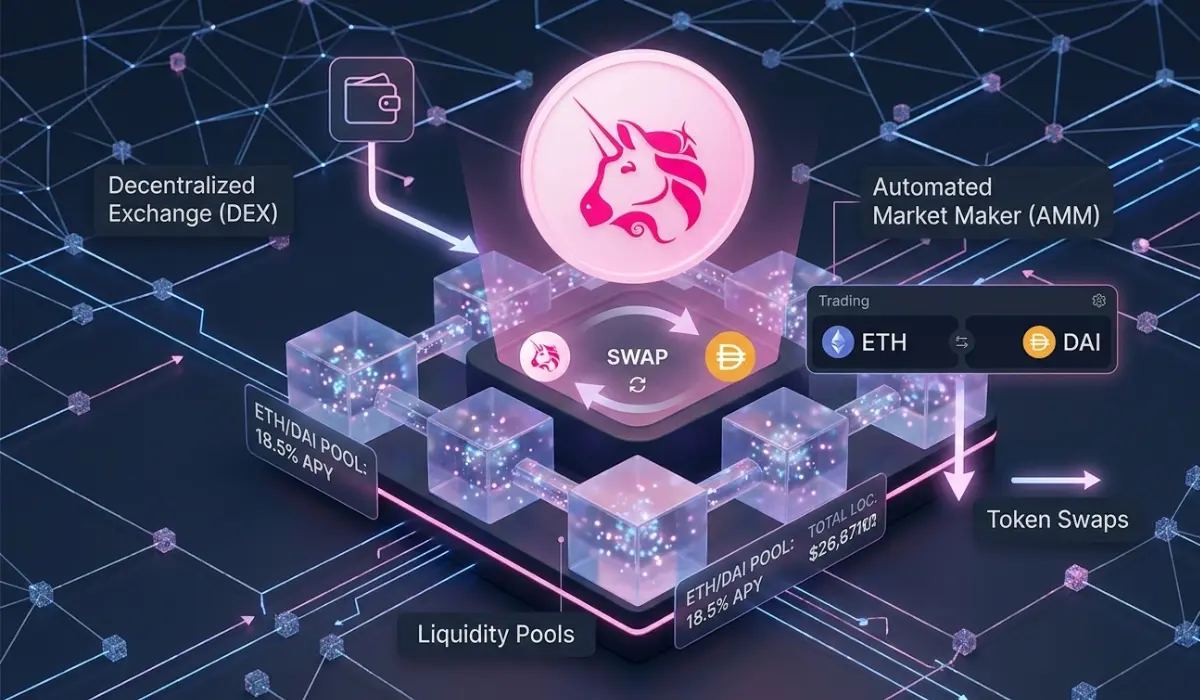
Uniswap is one of the largest decentralized exchanges (DEXs) in the world, enabling peer-to-peer cryptocurrency trading across several blockchain ecosystems. It utilizes an Automated Market Maker (AMM) protocol that allows digital assets to be traded transparently and trustlessly via smart contracts. Instead of matching buyers and sellers, it uses liquidity pools and a mathematical formula to determine the prices. Uniswap was created by Hayden Adams and launched on the Ethereum blockchain. Over time, Uniswap has become one of the defining pillars of decentralized finance (DeFi).
History of Uniswap
Uniswap was launched in 2018, successfully popularizing the AMM model. However, it is not the first decentralized exchange; discussions about decentralized exchanges began in 2014 after the collapse of Mt. Gox. Before the AMM model was popularized by Uniswap, platforms such as IDEX, EtherDelta, and ForkDelta served as the first generation of DEXs, laying the foundation for the decentralized financial ecosystem.
In 2016, Vitalik Buterin proposed the concept of on-chain AMMs using the formula “xy=k” in his Reddit post titled “Let’s run on-chain decentralized exchanges the way we run prediction markets.” This simple formula became the backbone of AMM-operated DEXs. Inspired by this concept, Hayden Adams, a former mechanical engineer, created Uniswap and launched it on the Ethereum network in 2018.
Uniswap quickly gained traction in the decentralized finance (DeFi) ecosystem. In 2020, Uniswap launched its governance token UNI. Over the years, Uniswap has evolved through multiple upgrades, currently on version 4, active from 2025. Major upgrades have included direct ERC-20 swaps (2020), concentrated liquidity (2021), and “Hooks” and singleton contract architecture introduced with v4 in 2025.
How Does Uniswap Work?
Uniswap uses liquidity pools instead of order books, where the users (called liquidity providers or LPs) deposit equal values of two tokens into the liquidity pool. The pool uses a constant product formula to determine the value.
In the formula “x. y = k.”
- x = amount of token A
- y = amount of token B
- k = constant
When someone swaps tokens, the ratio changes and automatically adjusts the price. Every trade pays a small fee, which ranges from 0.1% to 1%, depending on the liquidity pool, with 0.3% being the standard. In the absence of a central custodian, users can trade from their wallets as Uniswap never holds the funds.
The Importance of Uniswap in the Altcoin Ecosystem
Uniswap was a game-changer for the altcoins. Before the creation of decentralized exchanges like Uniswap, the listing of new tokens was a complex procedure in centralized exchanges. Uniswap has significantly lowered the barriers for new cryptocurrencies to access liquidity. Anyone can list an altcoin by creating a liquidity pool in Uniswap.
Advantages of Uniswap
Decentralized Operations
The trading activities are not controlled by any authorities. Instead, smart contracts handle every operation. This reduces the risk of exchange hacks or account freezes.
Permissionless Trading
Anyone with a compatible crypto wallet can use Uniswap. No signups or verifications required. This open access allows global participation in the decentralized finance ecosystem.
Transparent Execution
All transactions are recorded on-chain and can be verified publicly. This transparency allows users to verify transactions.
Non-Custodial Wallets
Unlike the centralized exchanges, users have control of their private keys and assets. Funds remain in the user’s wallet until a transaction is performed.
Advanced Liquidity Management
Concentrated liquidity allows the LPs to optimize capital distribution.
Disadvantages of Uniswap
Impermanent Loss
Due to the shifting value of assets, liquidity providers may experience “impermanent loss,” where their portfolio value is lower than if they had simply held the tokens in a private wallet.
MEV and Sandwich Risks
MEV (Maximal Extractable Value) exposes traders to risks such as sandwich attacks, where bots sandwich their transactions with the traders’ transactions.
Lack of Customer Support
Since Uniswap operates through a decentralized system, there is no support team to help. If you make an error during a transaction, it can result in the permanent loss of funds.
Smart Contract Vulnerabilities
As a decentralized protocol, the vulnerabilities can be exploited. Security risks such as reentrancy attacks, flash loan attacks, etc., can lead to severe financial loss.
Gas Fees
On the Ethereum mainnet, fees can be expensive due to network congestion, complex smart contract interaction, and high transaction demand.
Final Thoughts
Uniswap is one of the foundational pillars of the decentralized finance ecosystem. It reshaped the cryptomarket by reducing the dependency on centralized exchanges and established a new pricing model. However, Uniswap is not a magic tool that eliminates the risks of the crypto market: it’s highly volatile in nature. But if you prioritize decentralization and self-custody, Uniswap represents the ethos of crypto at its purest.
Frequently Asked Questions
Uniswap is a decentralized exchange (DEX) that can be used for token trading, liquidity provision, DeFi access, participating in governance, and NFT trading.
Uniswap’s smart contracts are publicly audited and remain transparent. However, Uniswap is exposed to the risks of smart contract vulnerabilities, scam tokens, and MEV attacks. The safety in Uniswap largely depends on user awareness.
Yes. Uniswap now enables direct fund transfer from the Uniswap wallet or web app to a bank account via built-in fiat off-ramp features.
Uniswap primarily operates as a decentralized exchange (DEX), but now it also offers a self-custody wallet for traders.
No. Uniswap does not require Know Your Customer (KYC) verification as it operates on a decentralized system.


