

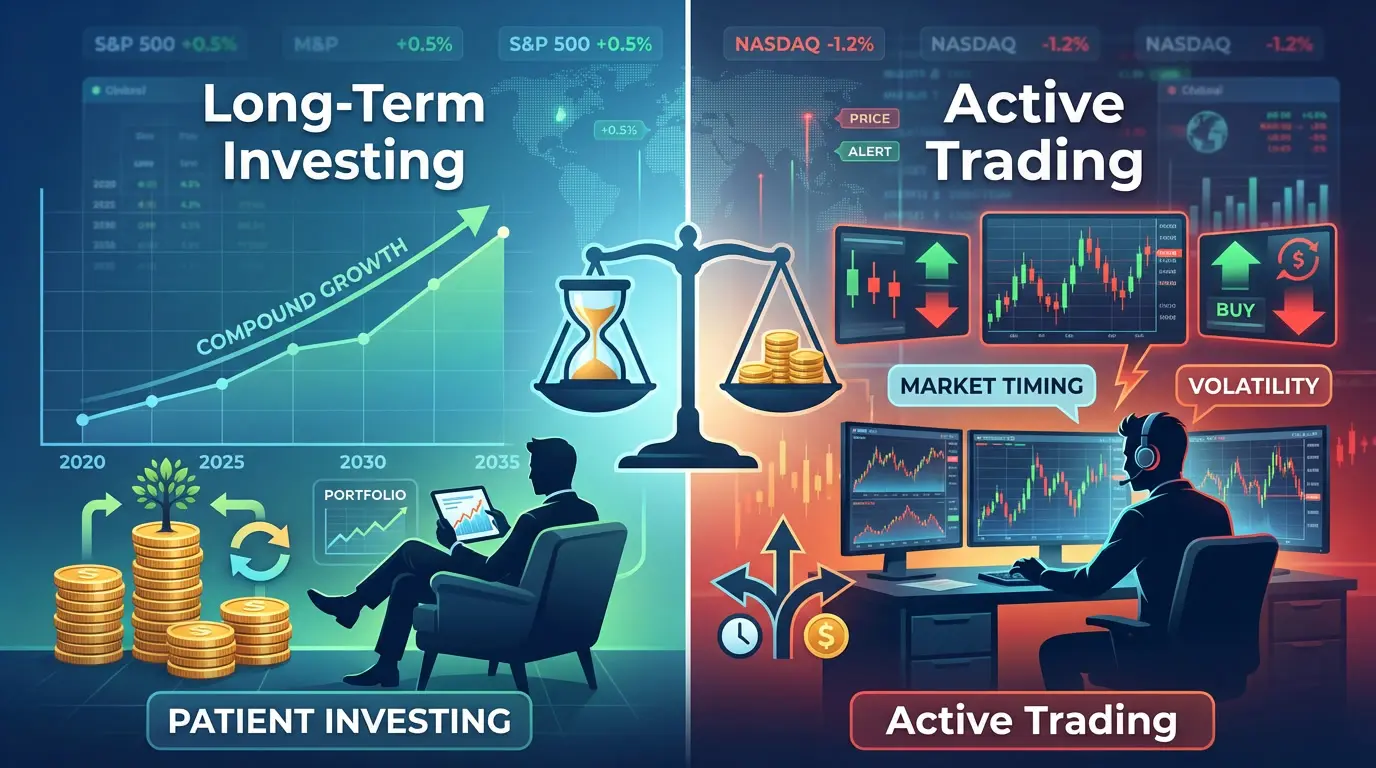
Long-term investing is a strategy that focuses on buying and holding quality assets for years to build wealth through compound growth. It demands low effort and offers lower risk. On the other hand, active trading seeks quick profits through frequent, short-term trades using technical analysis. It requires high expertise, significant time, and involves a higher risk. This article further discusses long-term investing and active trading, their differences, advantages, risks, and which strategy is better. So, keep reading to learn more.
Key Differences Between Long-Term Investing And Active Trading
Long-term investing focuses on company fundamentals, holding stocks for years to ride out volatility and benefit from compounding. It has lower transaction fees, lower taxes, less emotional stress, and benefits from compounding. However, it requires extreme patience and does not provide immediate income or excitement. When it comes to active trading, traders use technical analysis, charts, and news to exploit short-term price fluctuations, often holding positions for days or minutes. It has the potential for high returns, ability to profit in both rising and falling markets. It has a high risk of capital loss, significant time commitment, higher commissions, and higher tax liability.
Their key difference is that active trading carries high risk for higher potential rewards, while long-term investing aims for steady, consistent, lower-risk growth. Active trading requires daily, constant attention, and long-term investment is generally passive. Lastly, long-term investing uses fundamental analysis (business health), whereas active trading relies on technical analysis (price patterns).
Advantages of Long-Term Investing And Active Trading
Here are the advantages of long-term investing:
- Compound growth – Reinvested earnings can generate interest on interest, thereby multiplying wealth over years or decades.
- Time efficiency – Requires less daily monitoring, which ultimately reduces stress.
- Reduced risk and volatility – Long-term portfolios are generally less affected by daily market fluctuations, allowing investments to recover from downturns.
- Tax efficiency – Long-term capital gains benefit from lower tax rates compared to short-term trading.
- Lower costs – Fewer trades mean lower brokerage fees and transaction costs.
Here are the advantages of active trading:
- No long-term commitment – Traders are not tied to a company’s long-term performance.
- High liquidity – Active traders can quickly enter and exit positions, converting assets into cash easily.
- Capitalizing on volatility – Active traders use market volatility to their advantage rather than waiting for long-term recovery.
- Potential for high returns – Ability to profit from short-term market movements, volatility, and downward trends (short selling).
Risks Associated With Long-Term Investing And Active Trading
Long-term investing risks include inflation eroding purchasing power, prolonged market downturns, and company-specific failures, while active trading risks involve high volatility, significant capital loss, and emotional stress. Both methods require distinct strategies to manage liquidity issues, transaction costs, and market volatility. The risks associated with long-term investing include inflation risk, market volatility and downturns, company-specific risk, liquidity constraints, and opportunity cost. On the contrary, risks associated with active trading include high capital risk, transaction costs and taxes, leverage risk, emotional and time demands, and lack of skill.
Which Strategy Is Better For Beginners?
Long-term investing is generally considered better for beginners, as it offers a low-risk, low-stress, and less time-intensive approach to building wealth. By investing in diversified, low-cost assets for years or decades, beginners can avoid the high risks, high fees, and need for daily monitoring associated with active trading. Active trading is generally not recommended for beginners. It requires extensive market knowledge, quick decision-making, high risk tolerance, and intense, full-time dedication. While it offers potential for quick, immediate profits, it often results in losses for inexperienced traders.
Role Of Risk Management In Trading And Investing
Risk management is the practice of identifying, analyzing, and mitigating potential financial losses in trading and investing to protect capital, ensure longevity, and manage emotional decision-making. By using tools like stop-loss orders and position sizing, it balances risk-reward, allowing traders to survive market volatility. Proper risk management can help protect capital against, or limit the impact of large, unexpected market losses, preventing the ruin of a trading account. It removes sentiment-driven decisions by enforcing a data-driven, systematic approach to trading. In addition, it dictates how much capital is risked per trade, reducing the impact of a losing streak and allowing for consistent, long-term performance. Lastly, by calculating the risk-reward ratio, traders can identify high-probability setups and avoid trades where the potential loss outweighs the gain.
Final Thoughts
Long-term investing is generally better for building wealth, offering lower risk, lower taxes, and less stress by focusing on compounding returns over the years. Active trading attempts to profit from short-term volatility but requires intense daily monitoring, higher expertise, and carries significant risk, with most traders losing money. As for which one to choose among them, choose long-term investing if you want slow and steady growth, have a low-to-moderate risk tolerance, and prefer a passive approach. However, you can go for active trading if you have high expertise, significant time to monitor markets, and high capital risk tolerance. While a long-term, passive strategy is superior for wealth creation, active trading is often viewed as speculation.
FAQs
Long-term investing is generally considered better than trading for building sustainable wealth, as it offers lower risk, reduced stress, and higher success rates. While trading targets rapid, short-term profits, it requires intense, active management, higher skill, and carries significantly higher risks.
The golden rule of trading is to manage risk by never risking more than 0.5%–2% of your total capital on a single trade. This core principle ensures capital preservation, allowing traders to survive losing streaks and remain in the market long-term.


