

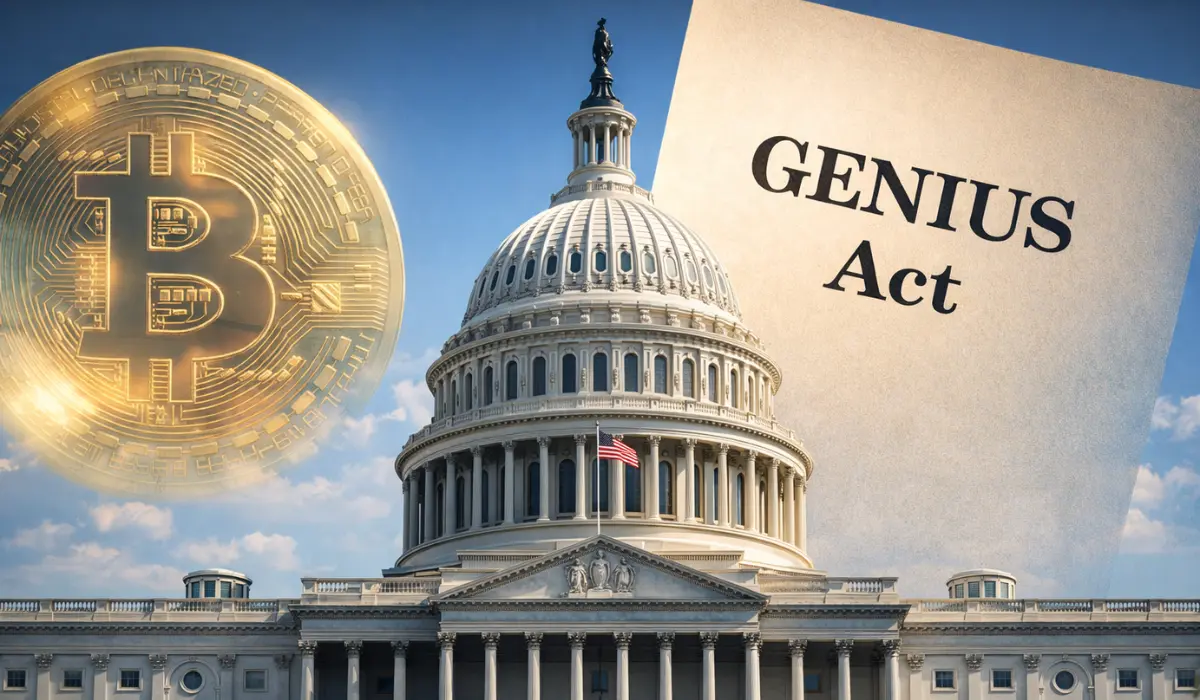
The Guiding and Establishing National Innovation for U.S. Stablecoins (GENIUS) Act was a piece of legislation passed by the US government on July 18, 2025, which was signed and approved by President Donald Trump. The act established the first-ever comprehensive federal framework for regulating dollar-backed “payment stablecoins.” It aims to provide a regulatory framework for the rapidly developing stablecoin market, which was previously unregulated.
The GENIUS Act requires issuers to hold 1:1 reserves in cash or short-term Treasurys, perform monthly disclosures, and comply with strict oversight to ensure consumer protection and financial stability. The legislation allows for a “dual-track” system, allowing for either federal or state-level regulatory oversight, with the Treasury Department overseeingthe overall implementation of the act. It also includes provisions for customer protection, such as granting coin holders priority for repayment in the event of an issuer’s bankruptcy.
This article will discuss the GENIUS Act in detail.
What are “Payment Stablecoins”?
“Payment Stablecoins” are at the heart of the GENIUS Act. It is defined as a digital asset that:
- Is designed to be used as a means of payment or settlement.
- Is issued by an entity obligated to convert, redeem, or repurchase it for a fixed monetary value (typically $1).
- Creates a reasonable expectation of price stability relative to a fiat currency.
Payment Stablecoins enable faster and cheaper cross-border transfers and instant settlements compared to traditional options. They account for lower costs for remittances and business payouts, especially in emerging markets or high-inflation regions. They are also programmable via smart contracts for automated compliance like AML/KYC checks. Payment Stablecoins are now increasingly used in trading, remittances, and as a hedge against local currency instability.
Key Provisions of the GENIUS Act
The GENIUS Act mandates that only specific entities, such as subsidiaries of insured depository institutions under federal banking agencies, nonbank institutions supervised by the Office of the Comptroller of the Currency (OCC), or state-chartered entities meeting federal standards or similar state regimes, can issue Payment Stablecoins. Stablecoins must be backed in a 1:1 ratio by US dollars or low-risk assets, with requirements for diversified reserves, interest rate risk management, capital liquidity, and monthly audits disclosed publicly.
The act mandates that the issuers of stablecoins should have 100% high-quality liquid assets (cash, Treasury bills) as backing, and these should be kept separate from operational funds. Issuers are classified as financial institutions under the Bank Secrecy Act, which means that they have to comply with AML, sanctions, and customer ID verification.
The Act prohibits paying interest or yield to holders of payment stablecoins. The operational limits of the issuers include issuing or redeeming stablecoins, managing reserves, and providing custodial services. Issuers with a market cap of over $10 billion fall under the purview of federal oversight, whereas smaller issuers are overseen by the individual state mechanisms. Moreover, the act prohibits treating custodied stablecoins as balance sheet liabilities.
The GENIUS Act prioritizes consumer protection. In the event of insolvency, stablecoin holders have priority, and the act bans individuals with certain criminal records from serving as officers.
Key Prohibitions Under the GENIUS Act
The GENIUS Act includes strict prohibitions to ensure the integrity of the stablecoins, limit risks, and prevent misleading practices among issuers and related parties. Only issuers such as subsidiaries of insured depository institutions, OCC-supervised nonbanks, or qualifying state-chartered entities are permitted to issue stablecoin under the GENIUS Act.
Stablecoin issuers are strictly forbidden from paying interest or “yield” to holders. This prevents stablecoins from becoming unregulated money-market funds and keeps them focused on their primary purpose of payments.
The act also prohibits large tech firms from issuing their own payment stablecoins. This is designed to keep financial services and big-tech data separate. The act also restricts individuals convicted of insider trading, embezzlement, cybercrime, money laundering, or financial fraud from serving as officers or directors of issuers, with penalties up to $1 million fines and 5 years imprisonment.
Challenges and Path Ahead
GENIUS Act implementation faces several regulatory, operational, and market challenges as it rolls out through 2026-2027. As far as regulatory hurdles are concerned, regulators must develop capital, liquidity, and risk management rules within 18 months, addressing risks from reserve assets like uninsured bank deposits that could trigger runs or interconnect banking and stablecoin instability.
Issuers must build robust programs for reserve segregation, transaction blocking, sanctions screening, and annual certifications to ensure compliance. Prohibitions on interest payments, tying products, and reserve rehypothecation limit business models, while technical requirements for freezing tokens and public disclosures demand significant upgrades. This adds to the operational risks.
To overcome these issues and clear the path ahead for the implementation of the GENIUS Act, relevant rules should be made by the Treasury, the OCC, the Fed, and the FDIC alongside state framework certifications. The success of the act hinges on coordinated oversight, global alignment to avoid arbitrage, and issuer adaptation, potentially boosting stablecoin legitimacy if the related challenges are addressed.


